
PCD Foundation Launches Network for Clinical Trials to Accelerate Treatment Development for Primary Ciliary Dyskinesia
Network unites a central coordinating center and three regional research hubs to make PCD studies faster, more accessible and more reliable
BLOOMINGTON, Minn. — October 27, 2026 — The Primary Ciliary Dyskinesia Foundation (PCD Foundation) today announced the launch of the PCD Foundation Network for Clinical Trials, a coordinated research network designed to accelerate the development and delivery of clinical trials for people living with primary ciliary dyskinesia (PCD).
PCD is an inherited disorder that affects cilia—the microscopic, hair-like structures that help clear mucus, bacteria and other particles from the airways. When cilia do not function properly, mucus builds up in the lungs, sinuses and ears, contributing to chronic infections, progressive lung damage and other lifelong health complications. Genetic research estimates that PCD affects at least 1 in 7,500 people worldwide, yet many people remain undiagnosed. There is currently no cure for PCD, and treatments developed specifically for the disease remain a significant unmet need.
New treatment development depends on patients and families who enroll in studies, share their experiences and help researchers shape what gets studied and how. Because people with diagnosed PCD are widely dispersed, that participation is especially valuable—and requires close coordination. The Network for Clinical Trials brings leading PCD researchers, clinical centers and the patient community into one coordinated network, making it easier, faster and more reliable to move potential treatments from idea to reality.
“For too long, diagnostic limitations and geographic dispersion of PCD have made it difficult to conduct the studies our community urgently needs,” said Michele Manion, president and executive director of the PCD Foundation. “This network connects expert investigators, proven research infrastructure and the lived experience of patients and families in one coordinated effort. It is a major step toward turning promising science into meaningful treatments for people with PCD.”
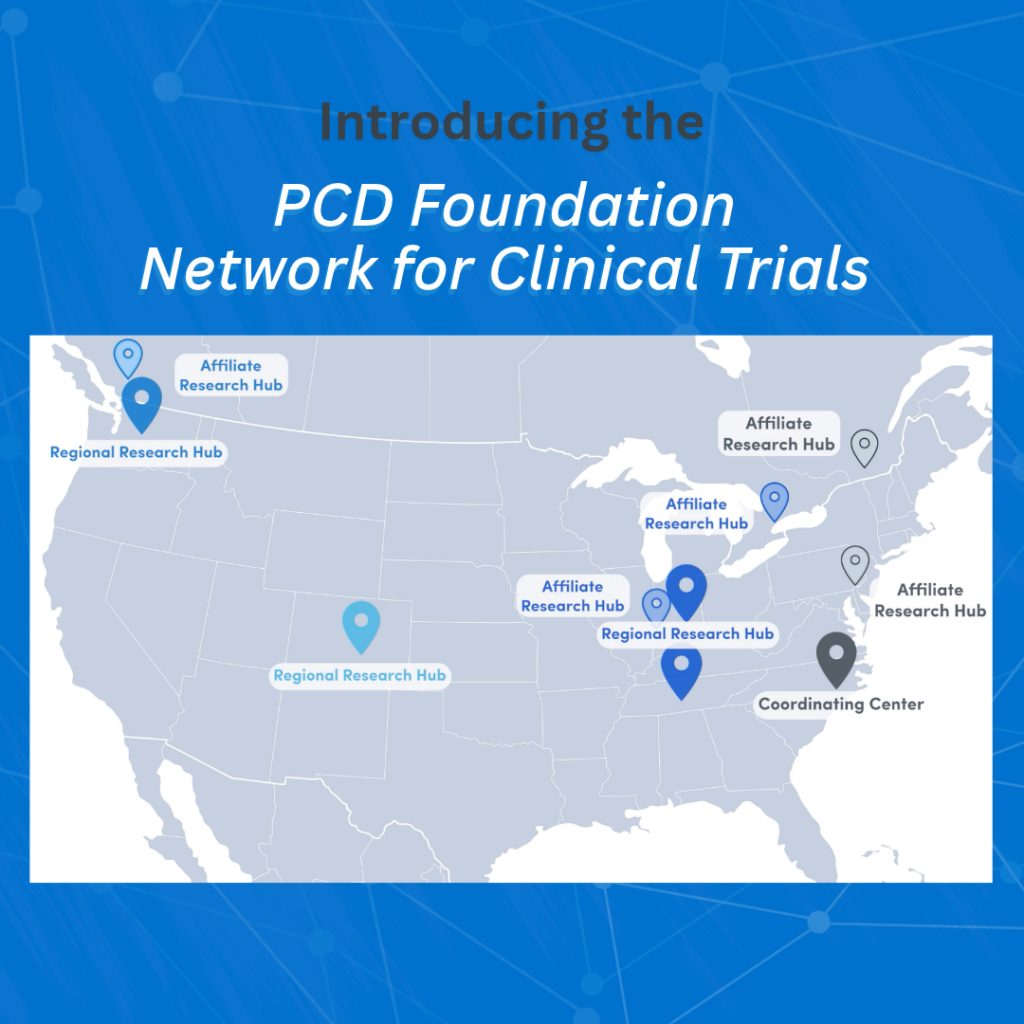
One Coordinating Center, Three Regional Research Hubs
The network’s initial core is composed of the following centers:
- University of North Carolina at Chapel Hill — Coordinating Center: Provides centralized leadership and operational coordination for the network, supporting efficient trial design and execution across sites.
- University of Washington and Seattle Children’s Hospital — Regional Research Hub: Connects expert PCD investigators and clinical teams with patients and families in the Pacific Northwest and surrounding region.
- Children’s Hospital Colorado and National Jewish Health — Regional Research Hub: Brings together pediatric and adult respiratory expertise to expand access to PCD research in the Mountain West and beyond.
- Vanderbilt University and Indiana University — Regional Research Hub: Extends coordinated trial capacity across the central United States and builds on established PCD research and registry infrastructure.
Additional affiliate research hubs broaden the network’s reach at Children’s Hospital of Philadelphia; Washington University in St. Louis; McGill University; the University of Toronto; and the University of British Columbia.
“PCD research has advanced through sustained collaboration among patients, families, clinicians and scientists,” said Margaret W. Leigh, MD, chair of the PCD Foundation Board of Directors. “By pairing centralized coordination with experienced regional teams, the Network for Clinical Trials creates a practical pathway to conduct rigorous studies, train the next generation of PCD researchers and move PCD-specific therapies forward.”
Built for PCD Clinical Research
The Network for Clinical Trials provides an integrated platform for PCD studies, including expert-driven trial design with protocols co-developed by PCD specialists; centralized contracting, regulatory review and safety oversight; dedicated clinical support at each research site; and access to PCD-specific diagnostics, the PCD Foundation Research Registry and a PCD biorepository. Patient engagement is built into the network through the PCD Foundation Patient Advisory Board, the regional research hubs and the Foundation’s Clinical and Research Centers Network.
Through this infrastructure, the PCD Foundation aims to accelerate trials that can change lives, prepare the next generation of physicians and scientists in PCD research, and enable discoveries that lead to treatments developed specifically for PCD.
To learn more about the PCD Foundation Network for Clinical Trials, visit www.pcdfoundation.org/the-pcd-foundation-network-for-clinical-trials/.
About the PCD Foundation
The Primary Ciliary Dyskinesia Foundation (PCD Foundation) is a nonprofit 501(c)(3) patient advocacy organization serving people with primary ciliary dyskinesia, an inherited ciliary disorder, and their caregivers. Founded in 2001, the Foundation was created to address significant unmet needs in the PCD community, including diagnostic challenges, a lack of evidence-based treatments, limited demographic data and an incomplete understanding of disease progression. Its programs have built the infrastructure needed to close those gaps, improve care and accelerate research. The PCD Foundation’s mission is to improve the quality of life for those affected by PCD and to develop the means to find a cure. It envisions a world free from illness and early death due to primary ciliary dyskinesia. Learn more at www.pcdfoundation.org.
Media Contact
Molly Blemker
mblemker@pcdfoundation.org
+1 (844) 287-3723 Ext. 2